
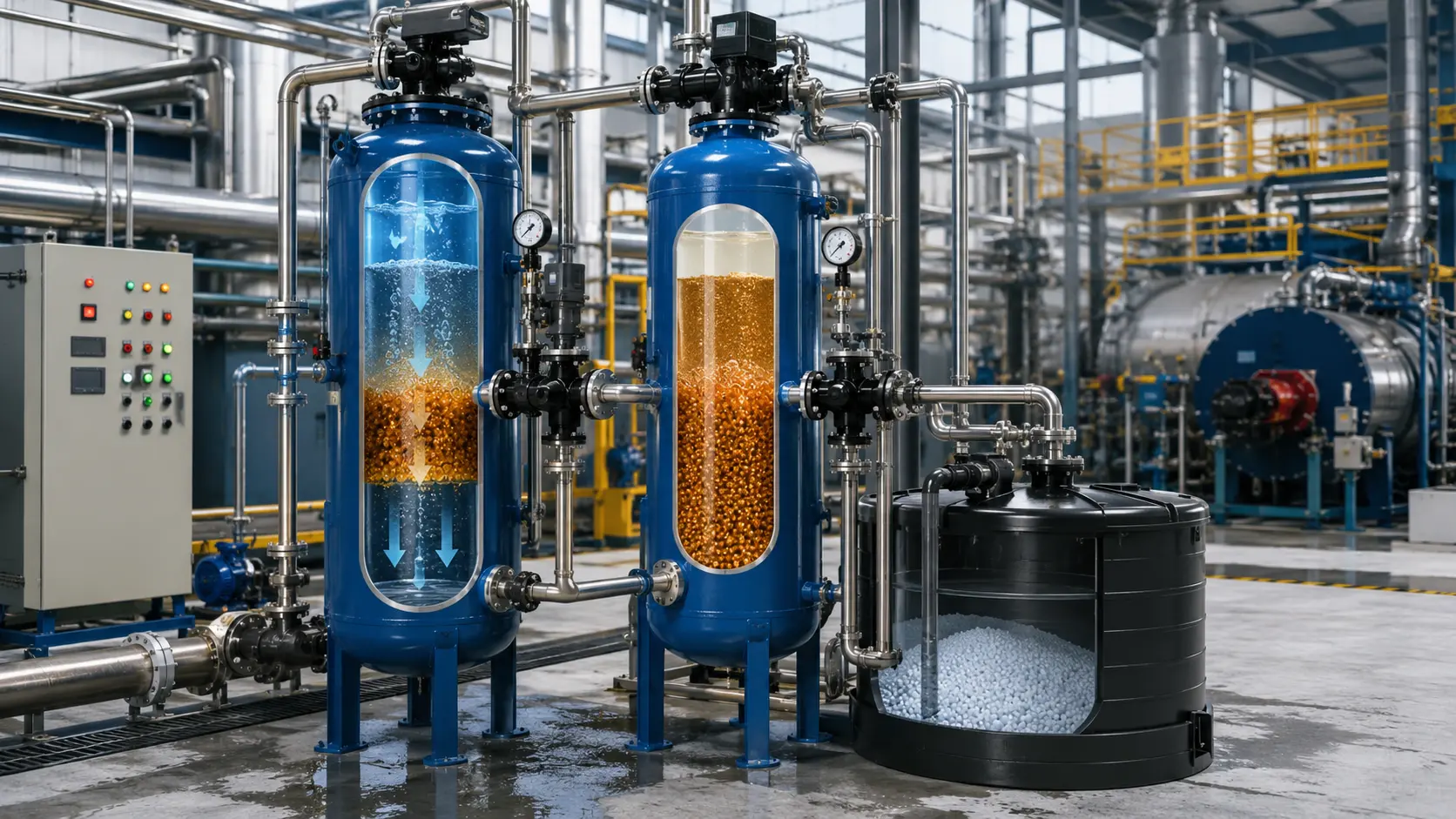
A water softener works until the resin runs out of sodium to trade. After that, it stops removing hardness and lets hard water through. Regeneration is the process that recharges the resin so it can soften again. Get it right, and the plant gives soft water for years. Get it wrong, on salt dose, timing, or rinse, and you waste salt, waste water, or let hardness slip into your boiler.
This guide explains the regeneration process step-by-step, the way an engineer would set it up and run it. It covers the cycle, the salt dose, how often to regenerate, the difference between co-current and counter-current regeneration, and how to spot and fix the common problems.
What is resin regeneration?
Resin regeneration is the process of recharging exhausted ion exchange resin so it can remove hardness again. In a water softener, a salt (sodium chloride) brine is passed through the resin to strip off the calcium and magnesium it has collected and reload it with sodium.
The resin is not consumed in normal service. It exchanges ions, fills up with hardness, and is then regenerated and reused. With clean feed water, the same resin lasts several years before it needs replacing.
How ion exchange softening works
A softener holds a bed of strong acid cation (SAC) resin in the sodium form. As hard water passes through, the resin captures calcium and magnesium and releases sodium in their place. Hardness stays on the resin, sodium goes into the water, and the water leaves soft.
This continues until the resin is loaded with hardness and has little sodium left to trade. The bed is then exhausted. If you keep running it, hardness starts to break through into the treated water, which is the signal that regeneration is due. You can read more about the underlying chemistry in our guide on what is hard water.
The resin regeneration cycle: step by step
A full regeneration has five stages. In a manual plant, an operator runs them through multiport valve positions. In an automatic plant a control valve runs the whole sequence on a timer or a volume count.
1. Backwash. Water flows up through the bed and lifts it, expanding the resin by around half its bed depth. This loosens the resin, flushes out trapped dirt and fine particles, and resettles the beads evenly. Backwash usually runs 5 to 15 minutes.
2. Brine draw (regeneration). Brine is drawn slowly through the resin. The high sodium concentration in the brine reverses the exchange, pushing the calcium and magnesium off the resin and replacing them with sodium. The brine is diluted from the saturated tank to roughly 8 to 12 percent at the resin, and the slow flow gives the exchange enough contact time, often 20 to 30 minutes.
3. Slow rinse (displacement rinse). A slow flow at about the brine-draw rate pushes the remaining brine through the bed. This lets the sodium finish exchanging and moves the brine and released hardness toward the drain without rushing it.
4. Fast rinse. A fast downflow at close to service rate washes out the leftover brine and hardness until the outlet runs soft and the chloride drops back to normal. This sets the resin up to give soft water from the first liter of the next service run.
5. Brine refill. Fresh water is added to the brine tank to dissolve more salt and prepare the brine for the next regeneration. The salt sits in contact with the water and saturates it, ready for next time.
After the refill, the plant returns to service and softens again
Co-current vs counter-current regeneration
The direction the brine flows through the bed changes how well the resin regenerates and how much salt it takes.
In co-current regeneration, the brine flows the same way as the service water, top to bottom. It is simpler and common on smaller plants, but it leaves a little more hardness on the resin at the outlet end, so the treated water has slightly higher leakage.
In countercurrent regeneration, the brine flows opposite to the service direction. This keeps the outlet end of the bed the most thoroughly regenerated, which gives lower hardness leakage and uses salt more efficiently. It is used where the plant needs very low outlet hardness, such as boiler feed, or where salt cost matters at high flows.
| Factor | Co-current | Counter-current |
|---|---|---|
| Brine direction | Same as service | Opposite to service |
| Hardness leakage | Higher | Lower |
| Salt efficiency | Lower | Higher |
| Complexity | Simpler | Higher |
| Best for | General duty, smaller plants | Low-leakage needs, high flow, salt saving |
How much salt does regeneration use?
The salt dose sets how much capacity you recover and how efficiently you use the salt. It is a trade-off.
A light dose, around 80 to 100 g of salt per liter of resin, uses salt efficiently but recovers less capacity per regeneration. A heavy dose, up to 150 to 240 g per liter, recovers more capacity but uses more salt for each kilogram of hardness removed. Most industrial softeners are set somewhere in the middle, near 100 to 160 g per liter, balancing salt cost against how often the plant regenerates.
| Salt dose (g/L resin) | Capacity recovered | Salt efficiency |
|---|---|---|
| 80 to 100 (light) | Lower | Best |
| 100 to 160 (medium) | Moderate | Balanced |
| 160 to 240 (heavy) | Highest | Worst |
Use clean industrial or food-grade softener salt. Salt with high insolubles fouls the brine system and the resin, so cheap salt costs more in the long run.
How often should a softener regenerate?
That depends on your feed hardness and how much soft water you draw between regenerations. There are two ways to trigger it.
Time-based (timer). The plant regenerates on a fixed schedule, for example, once a day, whether or not the resin is fully used. It is simple but can regenerate too early on low-demand days, wasting salt and water.
Volume-based (metered). The plant counts the water it treats and regenerates only when the resin is actually exhausted. This saves salt and water because it matches regeneration to real use. For plants with variable demand, metered control pays back through lower running costs.
As a guide, many industrial softeners regenerate once or twice a day. The exact frequency comes from the plant’s resin volume, the feed hardness, and the daily demand, which is set during sizing.
Water used in regeneration
Each regeneration sends water to drain in the backwash and rinse steps. As a rough figure, plan for a few times the resin bed volume per cycle, depending on bed size and valve settings. The spent regenerant is high in chloride and hardness.
If your site pays for effluent handling or works under a discharge consent, account for this drain water in the running cost. In India, effluent discharge is governed by Central Pollution Control Board (CPCB) norms, and some plants run a zero-liquid-discharge scheme, so plan for the regeneration waste early in the design.
Resin fouling and what shortens resin life
Resin lasts several years in clean service. What shortens it is feed-water quality, not age alone. Three problems cause most resin failures.
Iron fouling. Iron in the feed coats the resin beads, reduces capacity, and gives shorter service runs. If your water carries iron above about 0.3 mg/L, it needs an iron removal step ahead of the softener, and an iron-fouled bed may need a periodic acid or reducing-agent clean.
Chlorine attack. Free chlorine in the feed slowly oxidizes SAC resin, breaking down its structure so it loses capacity and the beads soften. Chlorinated feed water often needs de-chlorination, usually through an activated carbon filter, ahead of the softener.
Organic and suspended fouling. Organic matter and suspended solids coat the beads and raise the pressure drop. Good backwash and upstream filtration, such as a pressure sand filter, keep the bed clean.
Maintenance checklist
A softener stays reliable when these basics are kept up:
- Keep salt in the brine tank; never let it run empty
- Test outlet hardness on a set schedule to catch breakthrough early
- Watch inlet and outlet pressure for signs of fouling
- Check the brine draw and refill on each cycle
- Clean the brine tank periodically to clear insolubles
- Inspect the resin condition and test capacity once a year
- Keep a log of regeneration timing and salt use
Troubleshooting the regeneration process
Most softener problems trace back to salt, regeneration, or feed-water quality. This table covers the common ones.
| Symptom | Likely cause | What to check |
|---|---|---|
| Hard water after regeneration | Missed regeneration, empty brine tank, or short brine draw | Salt level, brine draw, valve sequence |
| Salty taste in treated water | Incomplete fast rinse | Rinse time and flow |
| High salt use | Over-dosing on a manual unit, leaking brine valve | Dose setting, brine valve |
| Short service runs | Feed harder than design, or fouled or lost resin | Feed hardness, resin condition |
| Resin in treated water | Damaged distributor or collector | Internal distributors |
| Rising pressure drop | Fouled or compacted resin, blocked distributor | Backwash, bed condition |
| Brine not drawing | Blocked injector or eductor, low water pressure | Injector, line pressure |
A note on DM resin regeneration
Softeners use salt because they work on the sodium cycle. Demineralization (DM) plants use different resins and different regenerants. The strong acid cation resin in a DM plant runs on the hydrogen cycle and is regenerated with acid, usually hydrochloric or sulfuric. The strong base anion resin runs on the hydroxide cycle and is regenerated with caustic soda. The cycle stages are similar in shape, backwash, regenerant, and rinse, but the chemicals and safety handling are different. If your plant uses a DM water plant alongside a softener, treat their regeneration systems as separate.
Why correct regeneration matters for your plant
Regeneration is where a softener earns its keep or quietly fails. A bed that is under-regenerated lets hardness through, and that hardness scales the equipment the softener was bought to protect. A bed that is overdosed wastes salt and money on every cycle. Setting the salt dose, the brine draw, the rinse, and the regeneration trigger correctly is what keeps outlet hardness low and running costs sensible.
This is also why the plant has to be sized and set up properly at commissioning. An industrial water softener plant that is matched to your water and flow, with the regeneration tuned to your demand, gives soft water with the least salt and water waste. If you are comparing options, our guide on water softener vs. RO plant explains where a softener fits against an RO system.
Frequently asked questions
What is resin regeneration? It is the process of recharging exhausted ion exchange resin so it can remove hardness again. In a softener, a salt brine strips the calcium and magnesium off the resin and reloads it with sodium.
How does water softener regeneration work? The cycle runs in five steps: backwash to clean and resettle the bed, brine draw to recharge the resin, slow rinse to displace the brine, fast rinse to wash out residual brine and hardness, and brine refill to prepare for the next cycle.
How long does regeneration take? A full cycle usually takes around 60 to 90 minutes, depending on bed size and valve settings. Backwash and the brine and rinse steps each take a portion of that.
How much salt does a softener use per regeneration? Roughly 100 to 160 g of salt per liter of resin for a medium dose. For a 50 L resin charge, that is about 5 to 8 kg per cycle. The exact figure depends on the dose the plant is set to.
How often should a water softener regenerate? It depends on feed hardness and daily demand. Many industrial plants regenerate once or twice a day. A metered valve regenerates only when the resin is exhausted, which saves salt and water.
What is the difference between co-current and counter-current regeneration? Co-current passes brine in the same direction as service; it is simpler but leaves slightly higher leakage. Countercurrent passes brine the opposite way; it gives lower leakage and better salt efficiency.
What salt should I use for regeneration? Clean industrial or food-grade softener salt. Salt with high insolubles fouls the brine system and the resin.
Can I use any salt in the brine tank? Use salt made for water softening. Avoid cheap salt with grit and insolubles, which clogs the brine system over time.
Why is my water hard after regeneration? Common causes are an empty brine tank, a missed or short brine draw, or a valve that did not sequence correctly. Check the salt level and the brine draw first.
Why does my softener use too much salt? On a manual unit, usually over-dosing. On any unit, a leaking brine valve or a timer set to regenerate too often. A metered control reduces salt use.
How do I know when the resin needs regenerating? When hardness starts to break through into the treated water. A metered valve tracks the volume treated and triggers regeneration before that happens.
What is brine in a water softener? Brine is the salt solution drawn from the brine tank to regenerate the resin. It is saturated in the tank and diluted to roughly 8 to 12 percent at the resin during the draw.
Does regeneration waste water? Yes, the backwash and rinse steps send water to drain, usually a few times the bed volume per cycle. A metered control reduces how often this happens.
How long does softener resin last? Several years in clean service. Iron, chlorine, and organic fouling shorten it, so feed-water quality decides resin life.
What damages ion exchange resin? Free chlorine oxidizes and breaks down the resin, iron fouls it, and organic matter coats it. Suspended solids and poor backwash also wear the beads.
Can fouled resin be cleaned? Iron and organic fouling can often be cleaned with the right chemical treatment, which restores some capacity. Resin damaged by chlorine attack cannot be recovered and needs replacing.
Is the resin regeneration process automatic? On an automatic plant, yes. A control valve runs the full cycle on a timer or volume count. On a manual plant, an operator runs each step.
What pretreatment protects softener resin? A pressure sand filter removes suspended solids, an activated carbon filter removes chlorine, and an iron removal step handles iron. These keep the resin clean and extend its life.
Conclusion
Regeneration is the heart of how a water softener keeps working. The five-step cycle, backwash, brine draw, slow rinse, fast rinse, and refill, strips the hardness off the resin and reloads it with sodium so it can soften again. The salt dose, the regeneration trigger, and the rinse settings decide your outlet hardness and your running cost.
Keep the brine tank topped up, test outlet hardness, watch for iron and chlorine in the feed, and set the regeneration to match real demand. Done right, the resin lasts years, and the plant protects your equipment from the least salt and water.
If you want a softener sized and set up for your water, UB Engineering Global designs and commissions water softener plants for industrial use, with the regeneration tuned to your flow and hardness