
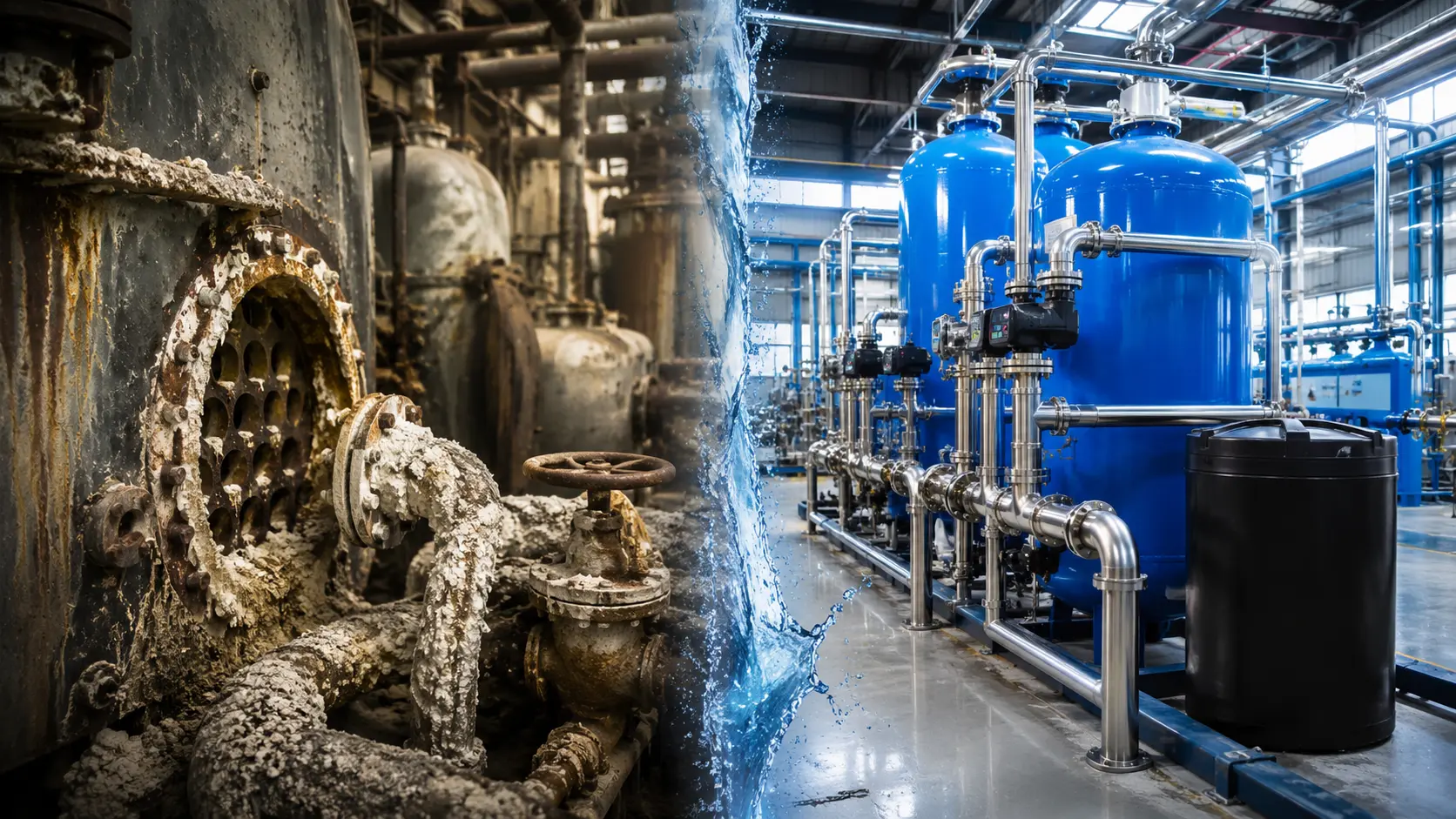
If your boiler is burning more fuel than it should, or your cooling tower needs cleaning more often than it used to, hard water is usually behind it. Across Punjab, Haryana, Rajasthan, and much of central and southern India, groundwater runs hard, and most plants drawing on bore wells deal with it whether they have measured it or not.
This guide explains what hard water is, what causes it, how it damages industrial equipment, and how to treat it. It is written for plant engineers, maintenance heads, and anyone deciding how to protect their equipment from scale.
What is hard water?
Hard water is water that carries a high level of dissolved calcium and magnesium. These two minerals are the main cause of hardness. The more calcium and magnesium the water holds, the harder it is.
Hardness is measured as calcium carbonate (CaCO3) equivalent, usually in milligrams per litre (mg/L), which is the same as parts per million (ppm). It does not matter whether the hardness comes from calcium or magnesium; both are counted together and reported as CaCO3.
The minerals themselves are not a health danger. The Bureau of Indian Standards (IS 10500:2012) sets a total hardness of 200 mg/L as the acceptable limit for drinking water and 600 mg/L as the permissible limit where no better source exists. The WHO and the US EPA treat hardness as an aesthetic and operational matter rather than a health risk. For industry, the problem is not health. It is scale.
What minerals cause hard water?
Calcium and magnesium are the two that matter. They enter water as it moves through rock and soil.
Other dissolved metals like iron, manganese, strontium, and aluminium can add to hardness, but in most groundwater their share is small next to calcium and magnesium. Iron deserves its own attention in industrial water because it fouls softener resin, which is covered later.
How hard water forms
Rainwater starts soft. As it soaks into the ground and moves through rock, it dissolves minerals along the way. Water passing through limestone, chalk, dolomite, and gypsum picks up calcium and magnesium and carries them into aquifers and bore wells.
This is why hardness follows geology. Regions sitting on these rock types have hard groundwater, and the hardness stays fairly steady unless the water source changes. A plant that switches from one bore well to another, or from bore water to canal water, can see its hardness change overnight, which is why a fresh water test matters whenever the source changes.
Types of hard water
Hardness comes in two forms, and the difference decides how it behaves when heated.
Temporary hardness
Temporary hardness comes from calcium and magnesium bicarbonates. It is called temporary because boiling removes it: heat breaks the bicarbonates down, the minerals drop out as scale, and the water that remains is softer. This is the scale you see caked inside a kettle or on a heating element. In a boiler, this same reaction lays scale on the tubes.
Permanent hardness
Permanent hardness comes from calcium and magnesium sulphates and chlorides. Boiling does not remove it. The minerals stay dissolved through heating and only come out when the water evaporates or concentrates. Permanent hardness needs a chemical treatment such as ion exchange to remove it.
Total hardness is the sum of the two. A water test reports total hardness, and a fuller test breaks it into the carbonate (temporary) and non-carbonate (permanent) parts.
Industrial sources of hard water
Most industrial hard water comes from groundwater drawn through bore wells, since that is the water most directly shaped by local rock. Municipal supply can also be hard, depending on the city’s source. Surface water from rivers and canals is often softer than bore water but varies by season and region.
For a plant, the practical point is simple: test the water you actually use, at the season you use it, because the number on a neighbour’s report or a government average will not match your tap.
How to measure water hardness
Hardness is measured as CaCO3 in mg/L (ppm) or in grains per gallon (gpg). One grain per gallon equals about 17.1 mg/L. Most lab and field reports in India use mg/L.
You can measure it three ways. A titration test in a lab gives the most accurate figure and splits total hardness into its carbonate and non-carbonate parts. A field test kit with drops gives a quick on-site reading. Test strips give a rough band, useful for a fast check but not for design. For sizing a treatment plant, use a proper lab titration, not a strip.
Water hardness chart
This is the common classification used to describe how hard a water is:
| Classification | Hardness (mg/L as CaCO3) | Grains per gallon |
|---|---|---|
| Soft | Below 60 | Below 3.5 |
| Moderately hard | 60 to 120 | 3.5 to 7 |
| Hard | 120 to 180 | 7 to 10.5 |
| Very hard | Above 180 | Above 10.5 |
Much of the groundwater in northern India sits in the hard to very hard band, often 200 to 500 mg/L, well above the BIS acceptable limit of 200 mg/L. That level causes real scaling in any equipment that heats or circulates the water.
Effects of hard water on industrial equipment
Hard water does its damage when it is heated or evaporated. The dissolved minerals leave the water and bond to metal as scale. Here is where it hurts, and why.
| Equipment | What hard water does |
|---|---|
| Boilers | Scale on tubes and drums blocks heat transfer, raises fuel use, and can overheat and crack tubes |
| Cooling towers | Scale on fill and heat-transfer surfaces cuts cooling and forces frequent cleaning |
| Heat exchangers | A scale layer drops the heat transfer rate, so the unit works harder for the same duty |
| Pipelines | Scale narrows the bore, cuts flow, raises pump pressure, and seizes valves |
| Industrial equipment | Pumps, spray nozzles, and process lines clog and wear faster |
| Manufacturing plants | In textiles, dyeing turns uneven and detergent use climbs; in food and beverage, product quality drifts |
| Commercial buildings | Geysers, chillers, and plumbing scale up, and maintenance cost rises across the building |
Boilers are where the cost is easiest to see. Scale is a poor conductor of heat, so the burner has to push heat through the deposit. A scale layer of about 1 mm can raise boiler fuel use by roughly 5 to 8 percent, and thicker scale makes it worse. On a plant with a real fuel bill, that is money lost every day the scale sits there.
Cooling towers and heat exchangers lose efficiency the same way. Scale on the heat-transfer surface means the equipment cannot reject or transfer heat as designed, so it runs longer and harder.
Pipelines and valves suffer slowly. Scale builds inside the bore, flow drops, pumps work against higher resistance, and small ports and valve seats clog until they fail.
Signs you have hard water
You often see hard water before you measure it:
- White, chalky scale on taps, heaters, nozzles, and inside kettles
- Rising boiler fuel consumption with no change in load
- More frequent descaling and cleaning of heat exchangers and cooling towers
- Reduced flow and higher pump pressure over time
- Poor lather and high detergent or soap use
- Spotting and uneven results in dyeing, washing, or finishing
Any one of these is a reason to test the water properly.
How to test hard water
For a quick check, a drop-based field kit tells you roughly where you stand in an hour. For anything you plan to spend money on, send a sample to a lab for a titration test. Ask for total hardness, carbonate and non-carbonate hardness, TDS, and iron. Those numbers decide both whether you need treatment and how to size it. Re-test whenever your water source changes.
Industrial hard water treatment methods
There are several ways to deal with hardness. They suit different needs.
Ion exchange softening. Water passes through a resin that swaps the calcium and magnesium for sodium. This removes hardness and is the standard method for industrial scale control. It is reliable, well understood, and works across a wide range of flows.
Lime softening. Lime is dosed to precipitate hardness out as a solid that settles and is removed. It suits very large flows and very hard water but needs more space, handling, and sludge management.
Reverse osmosis (RO). RO removes hardness along with most other dissolved solids. It is used where the plant needs low TDS, not only soft water. RO costs more to run and usually has a softener ahead of it to protect the membranes.
Nanofiltration. A membrane process that removes a large share of hardness with less pressure than RO. It is used in specific cases rather than as a general softening method.
Antiscalant dosing. Chemicals that hold scale in suspension rather than removing the minerals. This controls scale in some circuits but does not give you true soft water, so it is not suited to boiler feed.
Why water softener plants are the best solution
For scale control across most industrial duties, an ion exchange industrial water softener plant is the practical choice. It removes the calcium and magnesium that cause scale, runs continuously, scales from small to large flows, and costs little to run beyond salt.
The other methods have their place. Lime softening fits very large flows. RO fits low-TDS needs. Antiscalants manage scale where removal is not required. For a plant that simply needs soft water to protect boilers, cooling towers, and process lines, ion exchange does the job at the lowest cost and complexity.
This is also why a softener is the usual first step ahead of an RO plant or a DM plant: it takes the hardness load off the membranes or the DM resin and extends their life.
How ion exchange works
A softener holds a bed of strong acid cation resin inside a pressure vessel. The resin starts loaded with sodium ions. As hard water flows through, the resin grabs the calcium and magnesium and releases sodium in their place. Hardness stays on the resin, sodium goes into the water, and the water leaves soft. Sodium does not form scale.
The resin works until it is full of hardness. Then it is regenerated: a salt (sodium chloride) brine is drawn through the bed, which strips off the calcium and magnesium and reloads the resin with sodium, ready to soften again. On an automatic plant a control valve runs this cycle on its own. The result is a steady supply of soft water, usually below 5 ppm hardness, with no scaling downstream.
One thing to handle early: if your water carries iron above about 0.3 mg/L, it needs treating before the softener, because iron fouls the resin and cuts its life.
Benefits of soft water
Removing hardness gives clear, measurable gains:
- Lower boiler fuel use, because the tubes stay free of scale
- Longer equipment life and fewer descaling shutdowns
- Steady flow and pressure in pipelines and valves
- Protected RO membranes and DM resin
- Consistent quality in dyeing, washing, and food processing
- Lower detergent and chemical use
On a boiler, the fuel saving alone often pays for the softener in a short time.
Industry applications
Soft water matters wherever hard water costs money or quality. Boilers and steam plants need it to hold efficiency and avoid tube damage. Cooling towers need it to keep heat transfer in range. Textile plants need it for even dyeing and lower chemical use. Food and beverage plants need it to protect equipment and hold product quality. Pharmaceutical plants use softening as a step ahead of purified water systems. Laundries and hotels use it for better cleaning and longer equipment life. RO plants use it as pre-treatment.
If you are weighing up a hard water treatment solution for any of these, the starting point is the same: a water test, then a plant sized to your flow and hardness.
Frequently asked questions
What is hard water in simple terms? Water with a high level of dissolved calcium and magnesium. The more of these minerals it carries, the harder it is. Hardness is measured as CaCO3 in mg/L.
Is hard water bad for health? No. BIS, WHO, and the US EPA treat hardness as an aesthetic and operational issue, not a health risk. The problem for industry is scale, not safety.
What causes water to be hard? Water dissolves calcium and magnesium as it moves through rock such as limestone, chalk, and dolomite. Hardness follows local geology, which is why groundwater in some regions is much harder than others.
What is the difference between temporary and permanent hardness? Temporary hardness comes from bicarbonates and is removed by boiling. Permanent hardness comes from sulphates and chlorides and is not removed by boiling. It needs treatment such as ion exchange.
How is water hardness measured? As calcium carbonate (CaCO3) in mg/L (ppm) or grains per gallon. One grain per gallon equals about 17.1 mg/L. A lab titration gives the most accurate result.
What is considered hard water? Above 120 mg/L as CaCO3 is hard, and above 180 mg/L is very hard. Much of northern India’s groundwater sits at 200 to 500 mg/L.
What is the BIS limit for hardness in drinking water? IS 10500:2012 sets 200 mg/L as the acceptable limit and 600 mg/L as the permissible limit where no alternate source is available.
Does boiling remove hard water? Boiling removes temporary hardness only, by dropping the bicarbonates out as scale. It does not remove permanent hardness from sulphates and chlorides.
How does hard water damage a boiler? Heating drops the minerals out as scale on the tubes. Scale blocks heat transfer, so fuel use rises, and thick scale can overheat and crack tubes. Even a thin scale layer can add 5 to 8 percent to fuel use.
Can hard water damage an RO plant? Yes. Hardness scales RO membranes and shortens their life. A softener is the usual pre-treatment to protect the membranes.
What is the best way to treat industrial hard water? For scale control across most duties, an ion exchange water softener is the standard method. It removes hardness, runs continuously, and costs little to run beyond salt.
How does a water softener remove hardness? A resin bed swaps the calcium and magnesium in the water for sodium. When the resin fills with hardness, a salt brine regenerates it so it can soften again.
Does soft water have added sodium? A small amount, in exchange for the hardness removed. For industrial use this is not a concern.
What if my water also has iron? Iron above about 0.3 mg/L fouls softener resin and shortens its life, so it needs an iron removal step before the softener.
How do I know what size softener I need? It depends on your daily soft water demand and your feed hardness. Get a lab water test, then have the plant sized to those numbers and your flow rate.
Conclusion
Hard water is dissolved calcium and magnesium, and in a plant it shows up as scale: higher boiler fuel bills, more cleaning, lower flow, and shorter equipment life. The minerals are not a health risk, but the scale is a steady cost.
Testing the water is the first step. Once you know your hardness, an ion exchange softener removes the cause and keeps your equipment clean. If you want to size a plant for your flow and water, UB Engineering Global builds and commissions water softener plants for industrial use. Send your water test and daily demand, and we will size the right plant for your site.
Related reading: Industrial Water Softener Plant Manufacturer · DM Plant Manufacturer · Pressure Vessel Manufacturer