
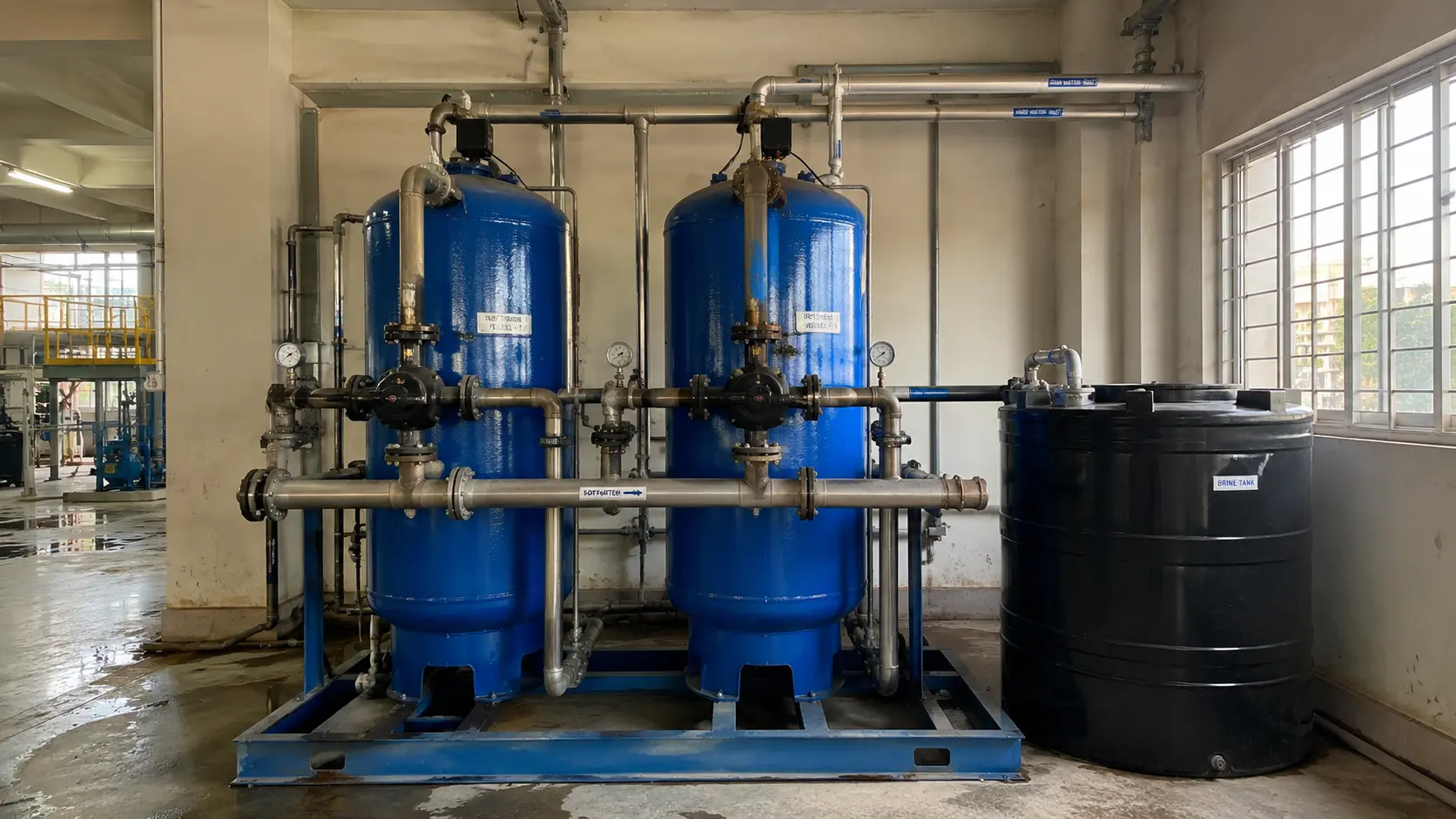
Plants often ask us for an RO plant when what they need is a softener and sometimes the other way around. The two solve different problems. A softener removes hardness so your equipment stops scaling. An RO plant removes most of the dissolved solids so the water is much purer. Pick the wrong one, and you either overspend on water you do not need or you fail to fix the problem that brought you here.
This guide explains how each system works, what each one removes, what they cost to run, and how to choose. It is written for plant engineers, maintenance heads, and buyers comparing the two for an industrial site.
What is a water softener plant?
A water softener plant removes hardness from water. Hardness is dissolved calcium and magnesium, the minerals that form scale when water is heated or evaporated. The softener swaps those minerals for sodium using ion-exchange resin, so the water leaves soft and no longer scales boilers, cooling towers, or pipelines.
A softener does not change the total amount of dissolved solids much. It trades one set of ions for another. The water is soft, but its TDS stays close to what it was.
What is an RO plant?
An RO (reverse osmosis) plant removes most of the dissolved solids from water, not just hardness. It pushes water through a semipermeable membrane under high pressure. The membrane lets water molecules through and holds back dissolved salts, so the water that comes out has much lower TDS than the water that went in.
RO gives you purer water. The trade-off is that it uses more power, needs more maintenance, and sends part of the feed water to drain as reject.
How does a water softener work?
A softener holds a bed of strong acid cation resin inside a pressure vessel. The resin starts loaded with sodium. As hard water passes through, the resin captures the calcium and magnesium and releases sodium in their place. Hardness stays on the resin, sodium goes into the water, and the water leaves soft, usually below 5 ppm hardness as CaCO₃.CaCO₃.CaCO₃.
When the resin fills with hardness, it is regenerated. A salt (sodium chloride) brine is drawn through the bed, stripping off the calcium and magnesium and reloading the resin with sodium. An automatic control valve runs this cycle on a timer or on a volume count. Between regenerations, the plant runs on line pressure and uses almost no power.
How does an RO plant work?
An RO plant pre-treats the feed water, then pushes it through membrane elements with a high-pressure pump. The membrane separates the flow into two streams: permeate, the low-TDS treated water you use, and reject (also called concentrate), which carries the rejected salts to drain.
Because the membrane is sensitive, an RO plant needs pre-treatment ahead of it: filtration to remove suspended solids, often a softener or antiscalant dosing to stop hardness scaling, and de-chlorination to protect the membrane. The high-pressure pump is what drives the process, and it is the main reason RO uses more power than a softener.
Water softener vs RO plant: quick comparison
| Factor | Water softener | RO plant |
|---|---|---|
| Main job | Removes hardness (Ca, Mg) | Removes most dissolved solids |
| Method | Ion exchange resin | Membrane under high pressure |
| TDS reduction | No, swaps ions | Yes, typically 90 to 99 percent |
| Hardness removal | Yes | Yes |
| Reject water | Only during regeneration | Continuous, part of feed to drain |
| Power use | Low | High (high-pressure pump) |
| Running cost | Salt, occasional resin | Power, membranes, antiscalant, reject |
| Output water | Soft, similar TDS | Low TDS, purified |
| Typical use | Scale control, boiler feed | Low-TDS or high-TDS feed water |
Detailed comparison
Working principle
A softener uses ion exchange: it trades calcium and magnesium for sodium on a resin. An RO plant uses pressure and a membrane to separate water from dissolved salts. The softener changes which minerals are in the water; RO removes most of them.
Water quality
A softener gives you soft water with about the same dissolved-solids level as the feed. RO gives you water with much lower TDS, closer to purified water. If your problem is scale, soft water solves it. If your problem is high TDS, only RO brings it down.
Minerals removed
A softener removes calcium and magnesium, plus some iron and manganese in small amounts. RO removes calcium, magnesium, sodium, chlorides, sulfates, nitrates, and most other dissolved ions, along with many larger contaminants.
TDS reduction
This is the point buyers most often get wrong. A softener does not reduce TDS. It replaces calcium and magnesium with sodium of roughly equal weight, so the total dissolved solids stay about the same. If you need lower TDS, you need RO, not a softener.
Hardness removal
Both remove hardness. A softener is built for it and does it at low cost. RO removes hardness as part of removing everything, but hardness scales the membrane, so RO plants usually have a softener or antiscalant ahead of them to handle the hardness first.
Operating cost
A softener is cheaper to run. Its main cost is salt, plus resin replacement every few years and a little power on automatic units. An RO plant costs more: membrane replacement, antiscalant, and other dosing; higher power for the pump; and the cost of the reject water that goes down thedown thedown the drain.
| Cost item | Water softener | RO plant |
|---|---|---|
| Energy | Low | High |
| Consumables | Salt, resin (few years) | Membranes, antiscalant, cartridges |
| Water loss | Small (regeneration only) | Continuous reject |
| Overall running cost | Lower | Higher |
Maintenance
| Task | Water softener | RO plant |
|---|---|---|
| Routine | Keep salt topped up andup andup and test outlet hardness | Check pressures, dosing, cartridge filters |
| Periodic | Clean brine tank andtank andtank and check resin yearly | Membrane cleaning (CIP), replace cartridges |
| Major | Resin replacement every few years | Membrane replacement on a cycle |
| Skill needed | Low | Higher |
A softener is simpler to run. An RO plant needs closer attention to pressures, dosing, and membrane condition.
Installation
A softener is a simpler install: vessel, resin, valve, brine tank, and frontal piping. An RO plant needs pre-treatment, a high-pressure pump, membrane housings, dosing systems, and instrumentation, so it takes more space, a morea morea more powerfulpowerfulpowerful supply, and a longer commissioning.
Water recovery
A softener recovers almost all the water it treats; only the regeneration backwash and rinse go to drain. An RO plant recovers a part of the feed, with the rest leaving as reject. Industrial RO recovery is commonly in the range of 50 to 75 percent andpercent andpercent and can be pushed higher with staging or concentrate recovery. If water is scarce or expensive at your site, this difference matters.
Power consumption
A softener uses very little power. An RO plant needs a high-pressure pump, so its power use is much higher per unit of water treated. On a large RO plant, pump power is a real line on the running cost.
Industrial applications
A softener suits scale control: boiler feed, cooling tower make-up, textile processing, laundries, anpre-treatment for RO. An RO plant suits cases where the feed TDS is too high or the process needs purified water: brackish bore water, high-TDS supply, drinking water from a poor source, and process water that needs low TDS.
Advantages of a water softener
- Removes hardness reliably at low cost
- Low power use, runs on line pressure between regenerations
- Simple to operate and maintain
- High water recovery, little waste
- Protects boilers, cooling towers, and RO membranes from scale
Advantages of an RO plant
- Removes most dissolved solids, not just hardness
- Brings down high TDS that a softener cannot touch
- Removes a wide range of contaminants in one step
- Produces purified water for sensitive processes and drinking
Disadvantages of a water softener
- Does not reduce TDS
- Adds a small amount of sodium to the water
- Needs salt and periodic resin replacement
- Does not remove most contaminants beyond hardness and some iron
Disadvantages of an RO plant
- Higher running cost: power, membranes, dosing
- Continuous reject water, lower recovery
- Needs pre-treatment, including hardness control
- More complex to run, needs closer maintenance
When should you choose a water softener?
Choose a softener when hardness is the problem and TDS is acceptable. The common cases are boiler feed water, cooling tower make-up, textile and laundry use, and any process where scale is the issue but the dissolved-solids level is fine as it is. If your bore water is hard but its TDS sits within your process limits, an industrial water softener plant is the right and cheaper choice.
When should you choose an RO plant?
Choose RO when the TDS itself is too high orhigh orhigh or the process needs purified water. Brackish or high-TDS bore water, drinking water from a poor source, and process water that needs low conductivity all call for RO. If a softener would leave the water still too salty for your use, RO is the system that fixes it.
Can both systems work together?
Yes, and on many industrial sites they do. A softener is placed ahead of the RO plant as pre-treatment. The softener removes the hardness, which protects the RO membranes from scaling and extends their life. The RO plant then brings down the TDS.
This pairing is common where the feed water is both hard and high in TDS. The softener handles the scale risk, the RO handles the salts, and the membranes last longer because they are not fighting hardness. If you are sizing a treatment train for difficult bore water, plan for both rather than asking one system to do the other’s job.
Industrial applications
| Industry / need | Better fit | Reason |
|---|---|---|
| Boiler feed water | Softener (or softener + RO for high-pressure boilers) | Scale control is the main need |
| Cooling tower make-up | Softener | Stops scaling on heat-transfer surfaces |
| Textile and laundry | Softener | Soft water for dyeing, washing, lower chemical use |
| High-TDS bore water | RO | Only RO brings TDS down |
| Drinking water from poor source | RO | Removes salts and contaminants |
| Pharma and process water | RO, often with softener pre-treatment | Needs low TDS and protected membranes |
| RO membrane protection | Softener before RO | Removes hardness that scales membranes |
Selection guide
| Your situation | Recommended system |
|---|---|
| Hard water, TDS within limits | Water softener |
| High TDS needs needs needs purified water | RO plant |
| Hard and high-TDS water | Softener + RO together |
| Boiler or cooling tower scaling | Water softener |
| Need drinking-grade water | RO plant |
| Protecting an existing RO plant | Add a softener ahead of it |
Buying guide
Start with a lab water test. Ask for hardness, TDS, iron, and chlorides. Those numbers tell you which system you need before you talk price.
Then match the system to the problem the test shows. If hardness is high and TDS is fine, size a softener to your daily demand and flow. If TDS is high, size an RO plant and plan its pre-treatment, including hardness control. If both are high, plan a softener ahead of an RO plant.
Size for flow as well as capacity, plan for demand growth over the next few years, and account for running cost, not just the purchase price. On RO, the reject water and its disposal matter too; in India, effluent discharge is governed by CPCB norms, and some sites need a zero-liquid-discharge plan, so factor that in early.
Common mistakes while choosing
- Buying RO to fix hardness. If hardness is the only problem, RO is more costlycostlycostly and complexcomplexcomplex than you need. A softener does the job cheaper.
- Expecting a softener to lower TDS. It will not. If your water is salty or high in TDS, a softener leaves it that way.
- Skipping the water test. Choosing basedChoosing basedChoosing based on guesswork leads to the wrong system or the wrong size.
- Running RO without softening on hard feed. The membranes scale and fail early. Soften first.
- Ignoring rejectedrejectedrejected water and disposal. An ROAn ROAn RO reject has a cost and a compliance angle. Plan for it.
- Sizing for today only. Build in headroom for demand growth.
Frequently asked questions
Is a water softener better than an RO plant? Neither is better overall; they do different jobs. A softener removes hardness at low cost. An RO plant removes most dissolved solids. The right one depends on whether your problem is scale (softener) or high TDS (RO).
Does a water softener reduce TDS? No. A softener swaps calcium and magnesium for sodium, so the total dissolved solids staystaystay about the same. To reduce TDS,TDS,TDS, you need an RO plant.
Do I need both a water softener and an RO system? Often, yes, when the feed water is both hard and high in TDS. The softener goes first to remove hardness and protect the RO membranes, and the RO then lowers the TDS.
Which system is best for industrial use? It depends on the water and the process. For scale control on boilers and cooling towers, a softener. For low-TDS or purified water, usewater, usewater, use RO. For difficult bore water, both together.
Does an RO plant remove hardness? Yes, RO removes hardness along with most other dissolved solids. But hardness scales the membrane, so a softener or antiscalant is used ahead of the RO to handle it.
What is the difference between soft water and RO water? Soft water has had its hardness removed but keeps a similar TDS. RO water has had most dissolved solids removed and is much purer.
Which is cheaper to run, a softener or an RO plant? A softener. Its main cost is salt. An RO plant costs more through power, membrane replacement, dosing, and reject water.
How much water does an RO plant waste? RO sends part of the feed to the drainthe drainthe drain as reject. Industrial recovery is commonly 50 to 75 percent, so 25 to 50 percent is leftis leftis left as reject, depending on the design.
Can a softener replace an RO plant? Only if your problem is hardness and your TDS is acceptable. If you need low TDS, a softener cannot replace RO.
Does soft water have added sodium? A small amount, in exchange for the hardness removed. For industrial use,use,use, this is not a concern. RO water, by contrast, has very low sodium.
Which uses more power? RO, because of its high-pressure pump. A softener uses very little.
What pre-treatment does an RO plant need? Filtration for suspended solids, hardness control by a softener or antiscalant, and de-chlorination to protect the membrane.
Is RO water good for boilers? RO water is very low in dissolved solids, which suits high-pressure boilers. Many plants use a softener for normal boilers and RO or DM water for high-pressure ones.
What if my water has iron? Iron fouls softener resin and also affects RO, so it needs an iron removal step ahead of either system if it is above about 0.3 mg/L.
How do I decide between them? Get a water test, then match the system to the result: a softenera softener for hardness with acceptable TDS, RO for high TDS, orTDS, or both for water that is hard and high in TDS.
Conclusion
A softener and an RO plant solve different problems. The softener removes hardness and stops scale at low cost, keeping the TDS about the same. The RO plant removes most dissolved solids and gives you purified water at a higher running cost and with reject water to manage.
The decision comes from your water test. If hardness is the issue and your TDS is fine, a softener is the right, cheaper choice. If your TDS is too high, you need RO. If the water is both hard and high in TDS, use a softener ahead of an RO plant so each system does the job it is built for.
UB Engineering Global designs and builds both. If you want a system matched to your water, send your test and daily demand, and we will recommend and size the right plant. Learn more on our water softener plant manufacturer page, or read what is hard water if you are still working out whether hardness is your problem
Related reading: Industrial Water Softener Plant · What Is Hard Water? · DM Water Plant · RO Plant · Water Treatment Plant