
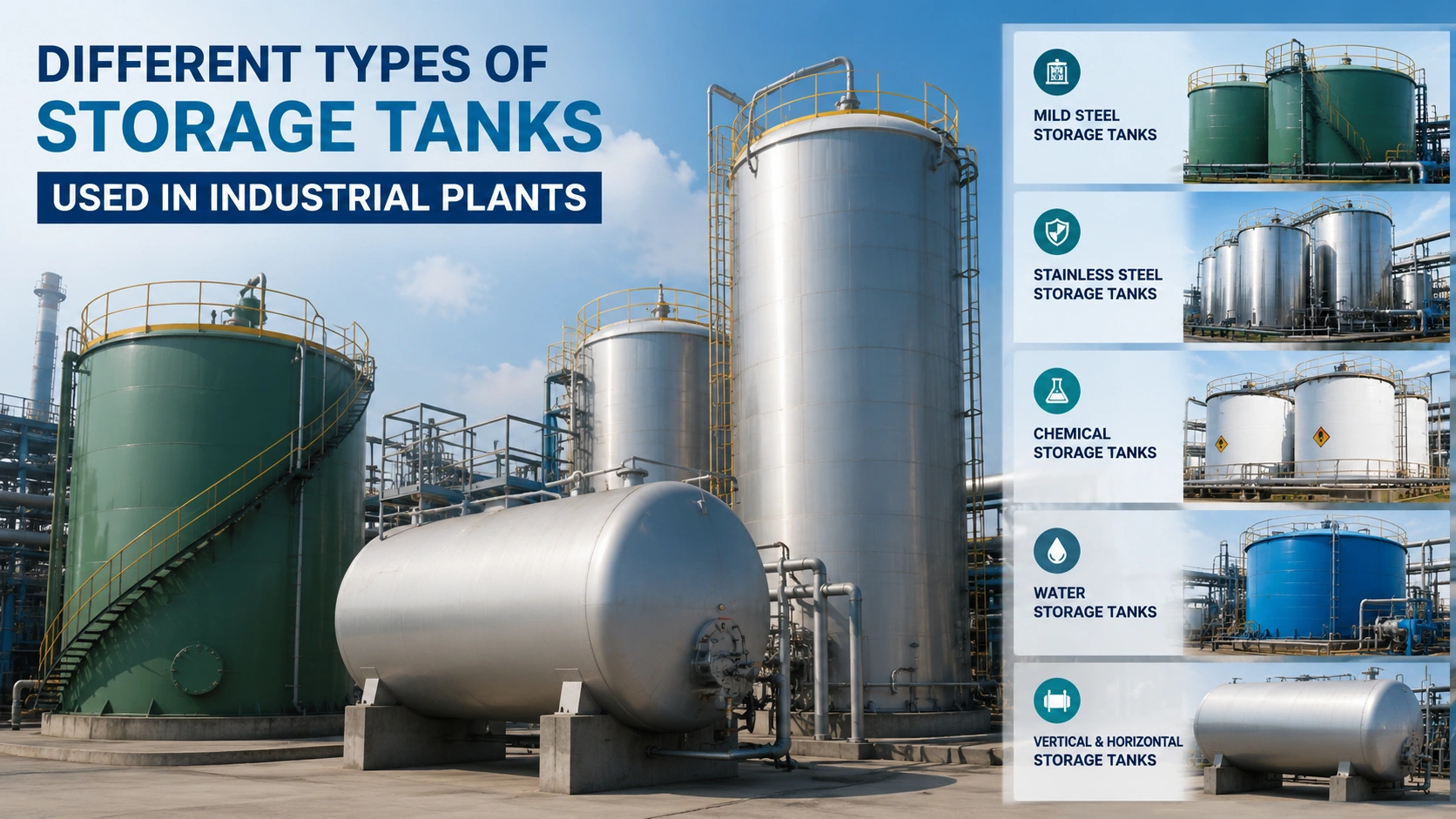
Storage tanks are a critical part of almost every industrial facility, holding everything from raw materials and process chemicals to water and finished liquids. Since plants deal with different substances, temperatures, and pressures, no single tank design works for every situation. Industrial storage tanks vary by material, shape, and construction based on what they need to hold and how they will be used. Understanding these differences helps plant managers, engineers, and procurement teams choose a setup that is safe, efficient, and cost-effective over the long term.
Why Industrial Plants Use Different Types of Storage Tanks
Tank selection is rarely a one-size-fits-all decision. Several practical factors influence which industrial tank types are suitable for a given application:
- Material being stored – chemicals, water, fuel, or process liquids each behave differently
- Required capacity – small utility tanks versus large bulk storage
- Operating temperature – ambient storage versus heated or chilled processes
- Pressure conditions – atmospheric tanks versus pressurized vessels
- Chemical properties – reactivity, corrosiveness, and purity requirements
- Installation conditions – available space, indoor or outdoor placement
- Safety and maintenance requirements – inspection access, cleaning needs, and regulatory compliance
Because these variables differ from one plant to another, facilities often use a combination of tank types rather than relying on a single design.
Common Types of Storage Tanks Used in Industrial Plants
Industrial plants typically choose from a few broad categories of storage tanks, each suited to particular materials and operating conditions.
Mild Steel Storage Tanks
Mild steel (MS) tanks are among the most widely used storage solutions in industrial settings due to their strength, structural durability, and cost efficiency. They are commonly used for storing water, oils, non-corrosive liquids, and various process materials where high chemical resistance is not the primary concern.
MS tanks are generally suitable for applications that demand a robust, long-lasting structure capable of handling large volumes and varying loads. Because mild steel is naturally susceptible to rust when exposed to moisture, corrosion protection—such as coatings, linings, or regular maintenance—is an important consideration when these tanks are used for prolonged storage or in humid environments. Overall, MS tanks are commonly considered where strength, practical durability, and dependable industrial storage are required without the added cost of specialized alloys.
Stainless Steel Storage Tanks
Stainless steel tanks are chosen primarily for their corrosion resistance and ability to maintain material purity. This makes them a preferred option for storing chemicals, food-grade liquids, pharmaceuticals, and other substances where contamination or reactivity with the tank surface must be minimized.
Because stainless steel resists rust, staining, and many forms of chemical attack, it is often selected for environments that demand hygiene, cleanliness, or compatibility with sensitive materials. While the material cost is typically higher than mild steel, the reduced maintenance and better performance in corrosive or hygienic conditions often justify the investment for specific processes.
Chemical Storage Tanks
Storing industrial chemicals safely depends heavily on matching the tank material to the properties of the substance being held. Some chemicals can react with certain metals or coatings, leading to corrosion, contamination, or safety hazards. For this reason, chemical storage tanks are engineered with careful attention to compatibility, wall thickness, and internal linings where needed.
These tanks are typically used in manufacturing units, processing plants, and facilities that handle raw or intermediate chemical products. The right material—whether mild steel with a protective lining, stainless steel, or another compatible option—depends on the specific chemical involved, and this should always be verified against manufacturer or industry guidelines before finalizing a tank.
Water Storage Tanks
Water storage is a routine but essential requirement in most industrial plants. Tanks used for this purpose typically hold process water, utility water for equipment cooling or cleaning, or reserve water for general plant operations and fire safety systems.
These tanks are usually designed for straightforward, large-volume storage without the complex compatibility concerns associated with chemical storage. Depending on plant layout and water usage patterns, water storage tanks may range from moderate utility-sized units to large bulk tanks supporting continuous operations.
Vertical and Horizontal Storage Tanks
Beyond material selection, tanks are also categorized by orientation—vertical or horizontal—based on available space, capacity needs, and accessibility.
Vertical tanks are often used where floor space is limited but height is available, making them a practical choice for facilities looking to maximize storage capacity within a smaller footprint. Horizontal tanks, on the other hand, are commonly used when a lower profile is preferred, such as for underground installations, transportation-linked storage, or areas with height restrictions. The choice between the two largely comes down to site layout, ease of installation, and how the tank will be accessed for filling, monitoring, or maintenance.
How to Choose the Right Type of Storage Tank
Selecting the right tank involves balancing several practical considerations rather than focusing on just one factor. Here is a simple framework to guide the decision:
- Material being stored – Confirm compatibility with the tank’s construction material.
- Required capacity – Estimate current and future storage volume needs.
- Operating temperature – Check if the tank must handle heated, cooled, or ambient conditions.
- Pressure conditions – Determine whether the application needs an atmospheric or pressurized design.
- Corrosion risk – Assess how the stored material and environment may affect the tank over time.
- Available installation space – Consider whether a vertical or horizontal layout fits the site better.
- Maintenance requirements – Factor in how easily the tank can be inspected, cleaned, and repaired.
- Safety and compliance requirements – Ensure the tank meets relevant industrial safety standards.
- Expected service life – Balance upfront cost against how long the tank needs to remain in service.
- Overall lifecycle cost – Weigh material cost, maintenance, and durability together, not just the initial price.
Working through these points early in the planning process helps avoid costly changes later and ensures the tank performs reliably for its intended use.
MS Tanks vs Stainless Steel Tanks
| Factor | Mild Steel (MS) Tanks | Stainless Steel Tanks |
|---|---|---|
| Material | Carbon steel, generally cost-effective | Chromium-alloyed steel, higher material cost |
| Corrosion Resistance | Moderate; requires coatings or linings for protection | High; naturally resistant to rust and many chemicals |
| Typical Applications | Water storage, oils, general industrial liquids, non-corrosive materials | Chemicals, food-grade liquids, pharmaceuticals, hygiene-sensitive processes |
| Maintenance Considerations | Periodic inspection and corrosion protection needed | Lower maintenance; easier to clean and sanitize |
| General Suitability | Best for high-strength, budget-conscious industrial storage | Best where purity, hygiene, or chemical resistance is essential |
Both tank types have a place in industrial operations, and many facilities use a mix of the two depending on what each area of the plant requires.
Key Factors Before Finalizing a Storage Tank
Before finalizing a storage tank, it helps to ask a few direct questions:
- Is the tank material fully compatible with what will be stored?
- Does the design account for current safety and compliance requirements?
- Is the capacity sized for both present needs and reasonable future growth?
- Has the installation site been evaluated for space, access, and orientation?
- What ongoing maintenance will the tank realistically require?
Answering these questions in advance helps prevent mismatched installations and unnecessary rework down the line.
Conclusion
Choosing the right industrial storage tank depends on the material being stored, operating conditions, required capacity, installation environment, safety expectations, and long-term maintenance needs. Mild steel, stainless steel, and application-specific chemical or water tanks each serve different purposes, and no single option suits every plant. For facilities with specific technical requirements or unusual operating conditions, it is worth consulting an experienced industrial tank supplier, such as through industrial MS tank solutions, to ensure the selected tank aligns with both current needs and future plans.
FAQs
What are the common types of storage tanks used in industries? Industrial plants commonly use mild steel tanks, stainless steel tanks, chemical storage tanks, and water storage tanks, along with vertical or horizontal configurations depending on space and capacity needs.
How do MS and stainless steel tanks differ? MS tanks offer strength and cost efficiency but need corrosion protection, while stainless steel tanks provide better natural corrosion resistance and are often preferred for chemicals or hygiene-sensitive storage.
How is storage tank material selected? Material selection depends mainly on compatibility with the stored substance, exposure to corrosion, temperature and pressure conditions, and the required service life of the tank.
What factors should be considered before selecting an industrial tank? Key factors include the material being stored, required capacity, temperature and pressure conditions, corrosion risk, available space, maintenance needs, and applicable safety standards.
Are vertical or horizontal tanks better for industrial use? Neither is universally better—vertical tanks suit sites with limited floor space, while horizontal tanks work well where height is restricted or a lower profile is needed. The right choice depends on site layout and accessibility requirements.