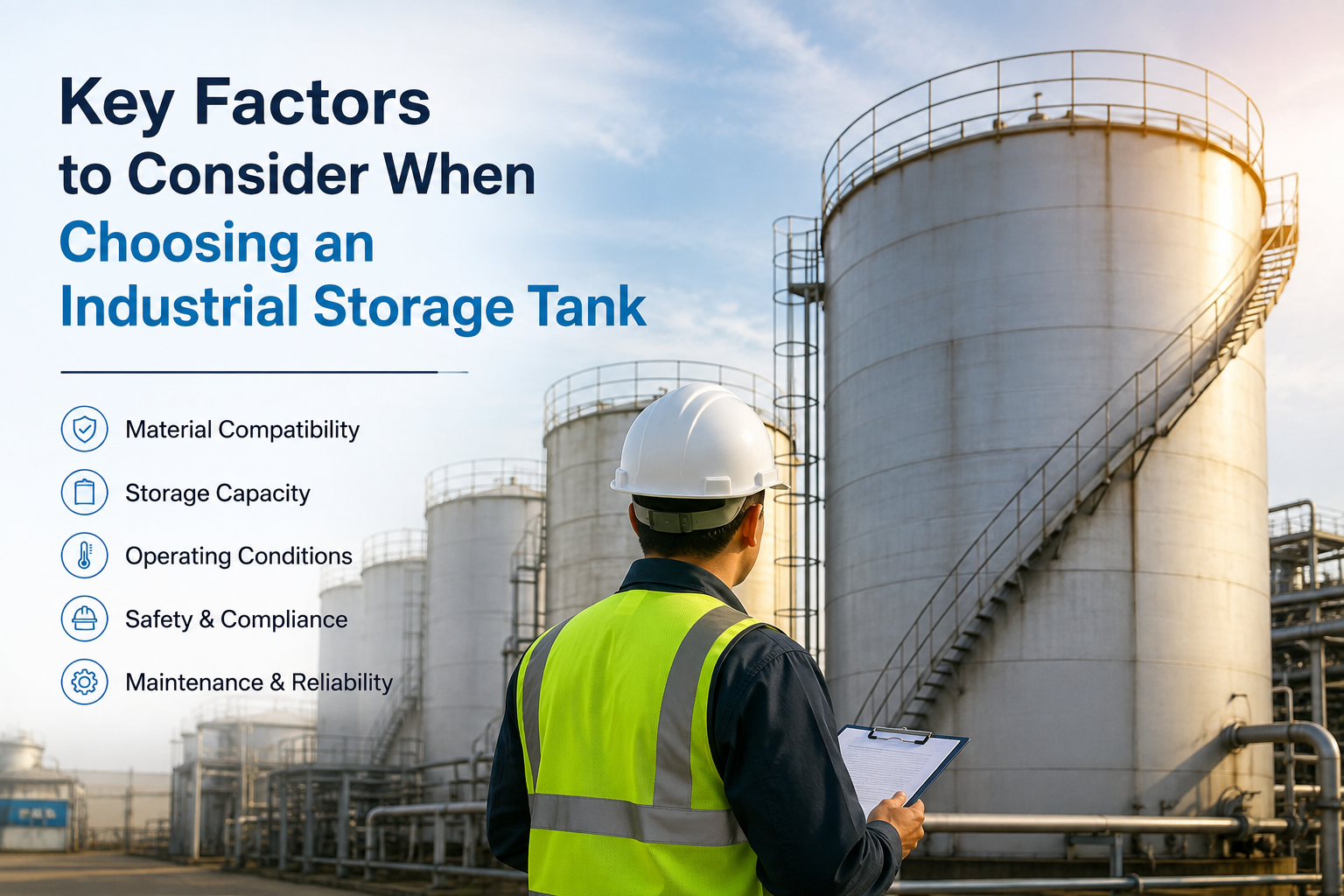
Choosing the right industrial storage tank directly affects plant safety, operational efficiency, and long-term maintenance costs. A tank that isn’t matched to the stored material, operating conditions, or site environment can lead to premature failure, contamination, or costly downtime. Several factors influence the right choice — material, capacity, the substance being stored, temperature, pressure, installation conditions, and ongoing maintenance needs. Understanding these factors before making a purchase decision helps procurement teams and engineers select a tank that performs reliably over its intended service life, rather than one that only meets short-term requirements.
1. Material Compatibility
The material stored in the tank is the single most important factor in selecting tank construction material. Chemicals, fuels, water, and process liquids each react differently with metals and coatings, so the wrong pairing can lead to corrosion, contamination, or structural degradation over time.
Key considerations include:
- Chemical reactivity — whether the stored substance reacts with, dissolves, or weakens the tank material
- Corrosion resistance — how well the material withstands prolonged exposure to the stored liquid
- Purity requirements — some applications (food-grade or pharmaceutical storage, for example) require materials that won’t leach into the stored product
Mild steel (MS) tanks are widely used for general industrial applications such as water, oils, and many non-corrosive liquids, largely because of their strength, weldability, and cost-effectiveness. For more aggressive chemicals, stainless steel, FRP, or lined tanks may be more appropriate. Reviewing the properties of the stored substance against the tank material — rather than choosing a material by default — helps avoid compatibility issues later.
2. Storage Capacity
Capacity planning goes beyond simply estimating how much liquid needs to be stored today. It requires looking at consumption or production rates, delivery or replenishment schedules, and how storage needs might change as operations scale.
A few practical points to evaluate:
- Current requirements — daily or batch-wise consumption and typical refill frequency
- Future needs — anticipated growth in production or storage demand
- Available space — capacity is often constrained by the physical footprint available at the site
Undersizing a tank leads to frequent refilling and operational inefficiency, while oversizing ties up capital and space unnecessarily. The goal is to size the tank around realistic current and near-term needs, with reasonable allowance for growth — not to maximize capacity for its own sake.
3. Operating Temperature and Pressure
Temperature and pressure conditions influence both the tank’s structural design and the material selected for construction. A tank designed for ambient, low-pressure storage will not perform reliably under elevated temperature or pressurized conditions.
Points to assess:
- Normal operating range — most general storage applications operate at or near atmospheric pressure and moderate temperatures
- Demanding conditions — processes involving heated liquids, pressurized storage, or significant temperature fluctuation require reinforced design, thicker walls, or specialized venting and relief systems
- Thermal expansion — materials expand and contract with temperature changes, which affects fittings, seals, and structural tolerances
Matching the tank’s design rating to actual operating conditions, rather than assuming standard specifications will suffice, reduces the risk of stress-related failure over time.
4. Corrosion and Environmental Conditions
While material compatibility addresses what happens inside the tank, corrosion resistance also depends on external environmental exposure. Outdoor tanks face humidity, rainfall, temperature swings, and in some regions, salt-air or industrial pollutants — all of which can accelerate external corrosion independent of the stored material.
Relevant considerations include:
- Whether the tank will be installed indoors or exposed to outdoor weather conditions
- Local environmental factors such as humidity, coastal exposure, or industrial emissions in the surrounding area
- The need for protective coatings, linings, or cathodic protection in high-exposure environments
Selecting a material and finish suited to both the internal contents and the external environment — rather than focusing on one and overlooking the other — supports a longer, more predictable service life.
5. Tank Design and Configuration
Tank configuration should match the practical realities of the installation site and operational workflow, not just theoretical capacity requirements.
Factors typically evaluated include:
- Horizontal vs. vertical orientation — vertical tanks often suit sites with limited floor space, while horizontal tanks can be easier to transport and install in constrained layouts
- Available installation space — footprint, height clearance, and access for future maintenance
- Inlet/outlet placement — positioning that supports efficient filling, discharge, and drainage
- Fittings and connections — nozzles, valves, and gauges appropriate to the application
- Inspection access — manways or access points that allow for internal inspection and cleaning without excessive downtime
For businesses evaluating tank design alongside material selection, working with a supplier experienced in industrial MS tank solutions can help align configuration choices with both site constraints and long-term operational needs.
6. Installation and Site Requirements
Even a well-specified tank can face problems if site conditions aren’t properly accounted for during planning.
Key site-related factors include:
- Available space — both for the tank itself and surrounding clearance for maintenance and safety access
- Foundation and support — soil conditions, load-bearing capacity, and the type of base or support structure required
- Accessibility — road or crane access for delivery and installation, especially for larger tanks
- Site-specific limitations — height restrictions, proximity to other equipment, or zoning-related constraints
Assessing these factors early in the planning process, rather than after the tank has been ordered, helps avoid delays and costly modifications during installation.
7. Safety and Compliance
Industrial storage tanks should be designed and installed with safety as a core requirement, not an afterthought. This includes structural integrity appropriate to the stored substance, adequate venting, and safe access for operation and inspection.
Considerations typically include:
- Design features that prevent overfilling, leakage, or uncontrolled pressure build-up
- Proper labeling, signage, and access control where hazardous materials are stored
- Alignment with applicable industry standards and local regulatory requirements for the specific application
- Professional installation and periodic inspection to confirm the tank continues to meet safety requirements over time
Since safety and compliance requirements vary by industry, application, and location, it’s advisable to confirm specific standards with a qualified supplier or regulatory body relevant to your operation.
8. Maintenance and Long-Term Reliability
A tank’s long-term reliability depends as much on maintenance practices as on its initial design and material. Planning for maintenance from the outset helps avoid unexpected downtime.
Ongoing maintenance considerations include:
- Routine inspection — checking for signs of corrosion, leaks, or structural wear
- Cleaning — periodic cleaning to prevent sediment build-up or contamination, particularly for tanks storing viscous or particulate-laden liquids
- Corrosion monitoring — tracking wall thickness or coating condition over time, especially in tanks storing corrosive substances
- Maintenance accessibility — ensuring the tank’s design allows technicians to reach key inspection and cleaning points without major disassembly
Tanks that are easy to inspect and maintain tend to have fewer unplanned failures and a more predictable service life than those where maintenance access was not considered during design.
9. Cost and Lifecycle Considerations
Purchase price is only one part of the total cost of owning an industrial storage tank. A complete cost evaluation should account for installation, ongoing maintenance, and the tank’s expected service life.
Factors to weigh include:
- Initial cost — the upfront price of the tank and any custom fittings or design features
- Installation cost — site preparation, foundation work, and delivery logistics
- Maintenance cost — inspection, cleaning, and any repairs over the tank’s lifetime
- Service life and reliability — how long the tank is expected to perform without major issues, and how consistently it operates under actual site conditions
A lower initial price can sometimes result in higher costs over time if it requires more frequent maintenance, earlier replacement, or unplanned repairs. Evaluating cost across the tank’s full lifecycle, rather than purchase price alone, generally supports a more economical long-term decision.
How to Choose the Right Industrial Storage Tank
Use the following checklist as a practical starting point when evaluating options:
- What material will be stored? Confirm chemical compatibility with the tank material.
- What capacity is required? Base this on current usage and reasonable future growth.
- What temperature and pressure conditions apply? Match the tank design to actual operating conditions.
- What corrosion risks exist? Consider both the stored substance and the external environment.
- What space and installation limitations exist? Account for footprint, access, and foundation requirements.
- What maintenance requirements should be considered? Plan for inspection and cleaning access from the start.
- What safety and compliance requirements apply? Confirm relevant standards for your industry and location.
Working through these questions in order helps narrow down the right material, capacity, and design before finalizing specifications with a supplier.
Conclusion
Selecting the right industrial storage tank comes down to matching the tank to its actual application — the material it will store, the capacity required, operating temperature and pressure, and the installation environment. Safety, maintenance accessibility, and lifecycle cost matter just as much as the initial specification. Because these factors often interact — for example, corrosive contents combined with outdoor exposure — it’s worth working with an experienced industrial tank supplier or manufacturer when specifications are complex, to ensure the final choice holds up reliably over the tank’s working life.
FAQs
1. How do I know what material is best for my industrial storage tank? The stored substance is the main factor — check its chemical properties against the tank material’s corrosion resistance and compatibility before deciding.
2. Is mild steel suitable for all types of industrial storage? Mild steel works well for many general-purpose applications like water and non-corrosive liquids, but highly corrosive or high-purity substances may require alternative materials or protective linings.
3. How often should an industrial storage tank be inspected? Inspection frequency depends on the stored material, environmental exposure, and applicable industry standards, but routine visual and structural checks should be part of any maintenance schedule.
4. Should I choose a vertical or horizontal tank? This depends mainly on available site space and installation constraints — vertical tanks suit limited floor space, while horizontal tanks can be easier to install in constrained layouts.
5. Is the cheapest tank option always the best value? Not necessarily. A lower purchase price can lead to higher long-term costs if it results in more frequent maintenance or a shorter service life, so lifecycle cost should be part of the decision.