
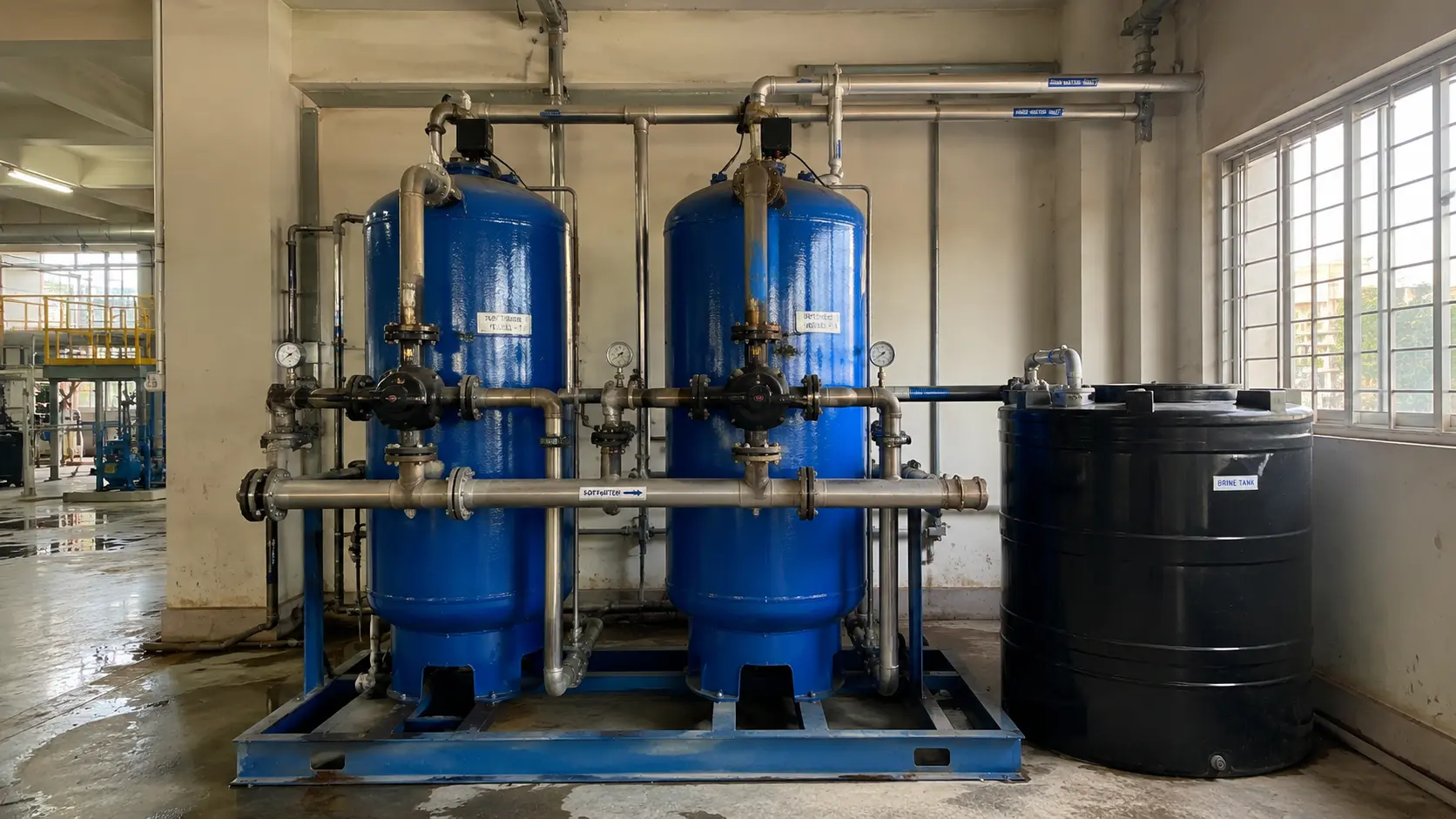
Industrial Water Softener Plant Manufacturer
UB Engineering Global designs, builds, and commissions industrial water softener plants that remove calcium and magnesium from hard water before it reaches your boilers, cooling towers, and process lines. We fabricate the pressure vessels, fit the resin and control valves in-house, and start the plant up on your site. The treated water leaves the plant soft, usually below 5 ppm hardness as CaCO₃, with no scaling downstream.
If you run a boiler, a cooling tower, an RO plant, or any process that heats or circulates water, hard water is already adding to your fuel bills and your maintenance. This page explains how a softener fixes that, how to size one correctly for your flow and water, and what to check before you place an order.
What hard water costs your plant:
Hard water carries dissolved calcium and magnesium. When that water is heated or evaporated, those minerals leave the solution and bond to metal surfaces as scale. The cost shows up in four places.
Boilers and heat exchangers. Scale is a poor conductor of heat. A 1 mm scale layer on a boiler tube can raise fuel consumption by roughly 5 to 8 percent because the burner has to force heat through the deposit. A thicker scale makes it worse and can lead to tube overheating and failure.
Cooling towers. Hardness drives scaling on the fill and on heat-transfer surfaces. That cuts cooling performance and forces more frequent, costly cleaning.
Pipelines and valves. Scale narrows pipe bores, blocks small ports, and seizes valves over time. Flow drops, pump pressure climbs, and energy use rises with it.
RO membranes. Hardness is a leading cause of membrane scaling. A softener placed ahead of an RO plant protects the membranes and extends their working life
A softener removes the cause. No calcium and magnesium at the inlet means no hardness scale forming downstream.
How an industrial water softener works
An industrial water softener removes hardness by passing water through a bed of ion exchange resin. The resin holds sodium and trades it for the calcium and magnesium in the water, so the water leaves soft and no longer forms a scale. When the resin is full of hardness, a salt brine regenerates it.
A softener uses ion exchange. Water passes down through a bed of strong acid cation (SAC) resin held inside a pressure vessel. The resin starts in the sodium form, with each bead loaded with sodium ions.
As hard water moves through the bed, the resin captures the calcium and magnesium ions and releases sodium ions in their place. Hardness stays on the resin, sodium goes into the water, and what leaves the vessel is soft water. Sodium does not form scale, so the treated water runs clean through your equipment.
This continues until the resin holds as much hardness as it can and has little sodium left to trade. At that point the bed is exhausted and needs regeneration.
The regeneration cycle
Regeneration recharges the resin with sodium using a salt (NaCl) brine drawn from the brine tank. A full cycle has five stages:
- Backwash. Water flows up through the bed to lift and loosen the resin, flushing out trapped dirt and resettling the beads.
- Brine draw. Strong brine is drawn slowly through the resin. The high sodium concentration reverses the exchange and pushes calcium and magnesium off the resin.
- Slow rinse. A slow flow moves the remaining brine through the bed so the sodium finishes exchanging.
- Fast rinse. A fast downflow washes out the leftover hardness and brine until the outlet runs soft and clear.
- Brine refill. Fresh water refills the brine tank and dissolves salt, ready for the next cycle.
In a manual plant, an operator runs these steps using multiport valve positions. In an automatic plant, a control valve runs the whole sequence on a timer or on a volume count.
A softener is a small number of parts that have to be matched correctly:
- Pressure vessel. Holds the resin bed under operating pressure. FRP for smaller duties, mild steel rubber-lined (MSRL), and stainless steel for industrial flows. We fabricate MS and SS vessels and pressure vessels in-house.
- Ion exchange resin. Strong acid cation resin in sodium form. The resin volume sets how much hardness the plant removes between regenerations.
- Control valve or multiport valve. Routes water through the service and regeneration steps. Manual, semi-automatic, or fully automatic.
- Brine tank and brine system. Stores salt and prepares the regeneration brine.
- Internal distributors and collectors. Spread water evenly across the bed and stop resin washout.
- Frontal piping and instruments. Inlet and outlet valves, sample cocks, pressure gauges, and flow indication.
Types of water softeners: manual, semi-automatic, automatic
The right choice depends on your flow, how many regenerations you run per day, and whether you have a trained operator on every shift.
| Factor | Manual | Semi-automatic | Fully automatic |
|---|---|---|---|
| Regeneration | The operator sets each valve step | Operator starts, valve sequences | Runs on timer or volume, no operator |
| Best for | Low flow, single shift | Medium flow | Continuous and high flow |
| Operator skill | Trained operator needed | Low | Minimal |
| Risk of human error | Higher | Medium | Low |
| Salt waste | Depends on operator discipline | Consistent | Lowest, metered |
| Upfront cost | Lowest | Medium | Highest |
If your plant runs around the clock, or you cannot guarantee a trained operator on every shift, automatic usually pays back through steady water quality and less wasted salt. For a single-shift operation with steady demand, a manual or semi-automatic plant keeps the upfront cost down.
Water hardness reference table
Hardness is measured as CaCO₃ equivalent in mg/L (the same as ppm) or in grains per gallon (gpg). One gpg equals about 17.1 mg/L.
| Classification | Hardness (mg/L as CaCO₃) | Grains per gallon |
|---|---|---|
| Soft | Below 60 | Below 3.5 |
| Moderately hard | 60 to 120 | 3.5 to 7 |
| Hard | 120 to 180 | 7 to 10.5 |
| Very hard | Above 180 | Above 10.5 |
Most groundwater across Punjab and northern India sits in the hard to very hard range, often 200 to 500 mg/L. The first step in any softener project is a water test for hardness, TDS, and iron, because those numbers drive the whole design.
How to size a water softener
Sizing answers one question: how much hardness do you need to remove between regenerations? Two inputs decide it: your daily soft water demand and your feed hardness.
The working figure for SAC resin is an operating capacity of about 50 g of hardness (as CaCO₃) removed per liter of resin, at a moderate salt dose of roughly 120 g/L. The figure moves with the salt dose: a lighter dose gives less capacity per liter, and a heavier dose gives more but uses more salt per kg of hardness removed. The 50 g/L value is a sound planning number. From there:
Hardness load (g) = Daily flow (L) × Feed hardness (mg/L) ÷ 1000
Resin volume (L)  = Hardness load (g) ÷ 50
Worked example. You need 10 m³/day (10,000 L) of soft water and your feed hardness is 250 mg/L.
Hardness load = 10,000 × 250 ÷ 1000 = 2,500 g per day
Resin volume  = 2,500 ÷ 50 = 50 L of resin
So a vessel holding about 50 litres of resin handles one day at these conditions before it regenerates. Double the hardness and you double the resin, or you regenerate twice as often.
Service flow rate sets the vessel diameter. Push too much flow through a small bed and the water slips past the resin without fully softening, so a plant is sized for both capacity and flow, not capacity alone.
Capacity selection table
This table shows the approximate resin volume needed for one regeneration per day, at the 50 g/L operating figure. Use it to get a feel for the size; final sizing comes from your water test.
| Daily soft water | Resin at 150 mg/L | Resin at 250 mg/L | Resin at 350 mg/L |
|---|---|---|---|
| 5 m³/day | 15 L | 25 L | 35 L |
| 10 m³/day | 30 L | 50 L | 70 L |
| 20 m³/day | 60 L | 100 L | 140 L |
| 50 m³/day | 150 L | 250 L | 350 L |
| 100 m³/day | 300 L | 500 L | 700 L |
Salt consumption guide
Salt is your main running cost. The amount per regeneration depends on the salt dose you design for, which trades off against how much of the resin’s capacity you use.
As a rule of thumb, plan for roughly 100 to 160 g of salt per litre of resin per regeneration. In the 50 L example above, that is about 5 to 8 kg of salt each time the plant regenerates.
A higher salt dose recovers more capacity per cycle but costs more salt per kg of hardness removed. A metered automatic valve helps, because it regenerates only when the resin is actually exhausted rather than on a fixed clock, which cuts salt waste on low-demand days.
Use clean industrial or food-grade softener salt. Cheap salt with high insolubles fouls the brine system and the resin.
Water used in regeneration
Each regeneration also uses water for the backwash and rinse steps, which goes to drain. As a rough guide, plan for a few times the resin bed volume in rinse and backwash water per cycle. The exact figure depends on the bed size and the valve settings. If you have a pollution-board consent or pay for effluent handling, account for this drain water in your running cost, and tell us if you need a low-water or recovery arrangement.
Technical specifications
Every plant we build is made to order, so the table shows typical ranges rather than fixed models. We size each unit to your water report and flow.
| Parameter | Typical range |
|---|---|
| Flow rate | 0.5 to 150 m³/hr [confirm your catalogue range] |
| Outlet hardness | Below 5 ppm as CaCO₃ (below 2 ppm on request for boiler feed) |
| Vessel material | FRP, MS, MSRL, SS304, SS316 |
| Operation | Manual, semi-automatic, fully automatic |
| Resin | Strong acid cation, sodium cycle |
| Regenerant | Sodium chloride (NaCl) |
| Working pressure | [insert your design pressure range] |
| Design code | [insert vessel design standard you build to] |
For boiler feed and other low-hardness duties, we can supply a two-stage or polishing arrangement to hold outlet hardness near zero.
Industry-wise applications
A softener earns its place wherever scale costs you money or quality.
| Industry | Why softening matters | Typical outlet target |
|---|---|---|
| Boilers and steam plants | Stops tube and drum scale, holds efficiency, cuts blowdown problems | Below 2 ppm |
| Cooling towers | Reduces scaling on heat-transfer surfaces, holds condenser approach | 2 to 5 ppm |
| Textile processing | Even dyeing and finishing, lower detergent and chemical use | Below 5 ppm |
| Food and beverage | Protects process equipment, consistent product quality | Below 5 ppm |
| Pharmaceuticals | Pre-treatment ahead of DM and RO-purified water systems | Below 2 ppm |
| Laundry and hospitality | Better cleaning, longer washer and linen life | 2 to 5 ppm |
| RO plants | Protects membranes from hardness scaling | Below 5 ppm |
Boiler feed water is the most common reason buyers call us because the fuel saving is easy to see on the bill.
Water softener vs DM plant
Buyers often confuse the two, and we manufacture both, so here is the difference.
A softener removes hardness, the calcium and magnesium, and swaps it for sodium. The TDS stays about the same; only the scaling minerals change. Softeners are for scale control.
A demineralization (DM) plant removes almost all dissolved ions and brings TDS down close to zero. DM water is for high-purity needs like high-pressure boilers, pharmaceutical process water, and some chemical processes.
Many plants use a softener for general scale control and a DM plant only where they truly need low TDS. If you are unsure which process your needs require, send us your water test and end-use, and we will tell you.
Iron and other feed water issues
Hardness is not the only thing in groundwater. Iron is common across North India, and it fouls softener resin if it is not handled first. Iron coats the resin beads, reduces capacity, and shortens resin life.
If your water test shows iron above about 0.3 mg/L, the design needs an iron removal step ahead of the softener, or a resin and regeneration scheme suited to the iron load. High turbidity, organic matter, and free chlorine also affect resin and may need pre-treatment. This is why the water test comes first: it tells us what the plant has to deal with, not just the hardness.
Our manufacturing and quality process
We build the plant rather than assemble bought-in parts. Our work covers vessel fabrication in MS, MSRL, and SS, internal distributor design, resin loading, valve and piping assembly, and final testing at our works in Ludhiana.
Industrial pressure vessels for water treatment are typically designed and tested to recognized codes such as IS 2825 or ASME Section VIII. [State the code you build to so buyers and consultants can verify it against their specification.]
Inspection and testing checklist
| Stage | Check |
|---|---|
| Incoming material | Plate and pipe verified against specification |
| Fabrication | Weld inspection on pressure vessels |
| Pressure test | Hydro test before lining and painting [confirm test pressure] |
| Lining (MSRL) | Rubber lining and surface protection checked |
| Resin | Volume and grade verified against the design |
| Pre-dispatch | Trial run and outlet hardness check |
Installation and commissioning
A typical project runs in clear stages so you know what to expect:
- Water test and sizing. We test your feed water and size the plant to your flow and hardness.
- Design and approval. Drawings and a specification go to you for sign-off.
- Fabrication. Vessels, frame, and piping are built and tested at our works.
- Delivery and erection. The plant is installed and connected to your inlet, outlet, drain, and power.
- Resin loading and brine setup. Resin is charged, and the brine system is filled.
- Commissioning. We run the first regeneration and service cycle, check outlet hardness, and hand over operator training.
Maintenance and troubleshooting
A softener is low-maintenance when it is run correctly. The basics fall on a simple schedule.
Maintenance schedule
| Frequency | Task |
|---|---|
| Daily | Check salt level in the brine tank and keep it topped up |
| Weekly | Test outlet hardness and note inlet and outlet pressure |
| Monthly | Check brine draw and refill; inspect for leaks |
| Quarterly | Clean the brine tank, clear insolubles |
| Yearly | Inspect resin condition and check distributor and valve |
Common faults and causes
| Symptom | Likely cause |
|---|---|
| Hard water at outlet | Missed regeneration, no salt in brine tank, or undersized resin |
| Low flow / high pressure drop | Fouled or compacted resin, blocked distributor |
| Resin in treated water | Damaged distributor or collector |
| Salty taste after service | Incomplete rinse step |
| High salt use | Over-dosing on a manual unit, or a leaking brine valve |
| Short service runs | Higher feed hardness than design, or resin loss over time |
Resin life and care
Resin lasts several years in clean service. What shortens it is feed-water quality, not age alone.
Free chlorine attacks SAC resin and breaks down the beads over time, so chlorinated feed may need de-chlorination first. Iron and organic fouling coat the beads and cut capacity. Repeated mechanical stress and poor backwash also wear the resin. Keep the feed clean, re-clean and andwash properly, and the reservoir will holdwashreservoir will holdhold its capacity far longer. Plan to test resin capacity yearly so you can replace it before it starts letting hardness through.
Common buying mistakes
A few mistakes come up again and again:
- Buying on price without a water test. The plant ends up undersized for the real hardness and never holds soft water through a full day.
- Sizing for capacity but ignoring flow rate. A bed too small for the peak flow lets hard water slip through even with capacity left.
- Choosing manual to save money, then having no trained operator. Missed or sloppy regenerations waste salt and let hard water through.
- Ignoring iron in the feed. Iron fouls the resin and cuts its life. It needs handling before the softener.
- No plan for demand growth. Size for where the plant will be in a few years, not only today.
Cost and ROI
Two costs matter: the plant itself and what it costs to run.
The purchase price depends on capacity, vessel material, and automation. Running cost is mostly salt, plus occasional resin replacement every few years and the small power for automatic valves.
The return comes from what the softener stops. On a boiler, removing scale holds the heat transfer where it should be, and even a thin scale layer adds 5 to 8 percent to fuel use. On a plant with a meaningful fuel bill, that saving alone can cover the softener in a short time. Add the avoided cost of descaling, premature tube replacement, and RO membrane damage, and the payback is usually clear once you put real numbers against your own fuel and maintenance spend.
If you share your daily water use, feed hardness, and current fuel bill, we can help you estimate the payback for your case.
Why choose UB Engineering Global
UB Engineering Global has 23+ years in industrial fabrication and water treatment, based in Ludhiana, Punjab. We manufacture pressure vessels, MS and SS tanks, DM plants, and water softener plants in-house, so the vessel, the internals, and the assembly come from one shop and one set of drawings. You can read more about our work and the industries we serve.
What you get working with us:
- Plants sized to your water test, not a generic model off a shelf
- In-house vessel fabrication in MS, MSRL, and SS
- Manual, semi-automatic, and fully automatic options
- Installation, commissioning, and after-sales support across the region
Frequently asked questions
What is an industrial water softener plant?
It is a plant that removes hardness, mainly calcium and magnesium, from water using ion exchange resin. The treated soft water no longer forms scale, which protects boilers, cooling towers, and process equipment
How does ion exchange remove hardness?
Water passes through a bed of resin loaded with sodium. The resin captures calcium and magnesium and releases sodium in their place, so the water leaves soft. Sodium does not form scale.
What is the difference between a softener and a DM plant?
A softener removes hardness and keeps TDS about the same. A DM plant removes almost all dissolved ions and brings TDS near zero. Softeners control scale; DM plants make high-purity water.
What outlet hardness can a softener achieve?
A well-run plant holds outlet hardness below 5 ppm as CaCO₃. With a polishing stage, it can reach below 2 ppm, which suits boiler feed.
What resin is used?
Strong acid cation resin in the sodium form. The resin volume decides how much hardness the plant removes between regenerations.
How does regeneration work?
A salt brine is drawn through the resin to strip off the captured calcium and magnesium and reload the resin with sodium. The cycle runs backwash, brine draw, slow rinse, fast rinse, and brine refill.
What capacity do I need?
That comes from your daily soft water requirement and your feed hardness. As a guide, resin volume in liters is roughly daily demand in m³ times hardness in mg/L divided by 50. Send a water test and we will size it exactly.
Should I choose manual or automatic?
Automatic suits continuous or high flow and sites where operator time is short. Manual or semi-automatic suits steady, single-shift demand where you want a lower upfront cost.
Should I choose manual or automatic?
Automatic suits continuous or high flow and sites where operator time is short. Manual or semi-automatic suits steady, single-shift demand where you want a lower upfront cost.
Should I choose manual or automatic?
Automatic suits continuous or high flow and sites where operator time is short. Manual or semi-automatic suits steady, single-shift demand where you want a lower upfront cost.
Can a softener handle very hard water above 300 ppm?
Yes. Higher hardness means more resin or more frequent regeneration, so the plant is sized for it. The water test sets the design.
What if my water also has iron?
Iron fouls the resin and shortens its life. If iron is above about 0.3 mg/L, the design needs an iron removal step before the softener.
Can I use a softener before my RO plant?
Yes. A softener is a common pre-treatment for RO because it protects the membranes from hardness scaling.
How much salt will it use?
Roughly 100 to 160 g of salt per liter of resin per regeneration. For a 50 L resin charge, that is about 5 to 8 kg per cycle. We give the exact figure once the plant is sized.
Does soft water have added sodium?
Yes, a small amount, in exchange for the hardness removed. For industrial use, this is not a concern.
How much does an industrial water softener plant cost?
It depends on capacity, vessel material, and automation. Share your flow and water test, and we will quote a plant sized to your need.
What are the running costs besides salt?
Mainly resin replacement every few years and a small amount of power for automatic valves. Salt is the main ongoing cost.
What is the payback from softening boiler feed water?
Removing scale holds boiler efficiency. Even a thin scale layer adds 5 to 8 percent to fuel use, so on a plant with a real fuel bill,bill, the softener often pays back quickly.
What is the payback from softening boiler feed water?
Removing scale holds boiler efficiency. Even a thin scale layer adds 5 to 8 percent to fuel use, so on a plant with a real fuel bill,bill, the softener often pays back quickly.
What is the payback from softening boiler feed water?
Removing scale holds boiler efficiency. Even a thin scale layer adds 5 to 8 percent to fuel use, so on a plant with a real fuel bill,bill, the softener often pays back quickly.
What is the payback from softening boiler feed water?
Removing scale holds boiler efficiency. Even a thin scale layer adds 5 to 8 percent to fuel use, so on a plant with a real fuel bill,bill, the softener often pays back quickly.
How do I maintain the plant?
Keep salt in the brine tank, test outlet hardness on a schedule, watch the pressure drop, and clean the brine tank periodically. Test resin capacity yearly.
How do I maintain the plant?
Keep salt in the brine tank, test outlet hardness on a schedule, watch the pressure drop, and clean the brine tank periodically. Test resin capacity yearly.
What are the common faults?
Hard water at the outlet usually means a missed regeneration or empty brine tank. A rising pressure drop points to fouled resin. Most issues trace back to salt, regeneration, or feed-water quality.
Do you install and commission the plant?
Yes. We deliver, erect, load resin, run the first cycle, check outlet hardness, and train your operator at handover.
Do you provide after-sales service?
Yes, we support installation, commissioning, and ongoing service across the region. [Add AMC details if you offer them.]
Can the plant be customized, and what is the lead time?
Every plant is made to order in vessel material, automation, and flow. [Add your typical lead time so buyers can plan.]
Is a salt-based softener better than a salt-free or magnetic device?
A salt-based ion exchange softener actually removes hardness, which is what stops scale. Salt-free, magnetic, and template-assisted devices change how scale forms but do not remove calcium and magnesium, so they are not suited to boiler feed or other duties that need true soft water. For industrial-scale control, ion exchange is the proven method.
Is a salt-based softener better than a salt-free or magnetic device?
A salt-based ion exchange softener actually removes hardness, which is what stops scale. Salt-free, magnetic, and template-assisted devices change how scale forms but do not remove calcium and magnesium, so they are not suited to boiler feed or other duties that need true soft water. For industrial-scale control, ion exchange is the proven method.
Is a salt-based softener better than a salt-free or magnetic device?
A salt-based ion exchange softener actually removes hardness, which is what stops scale. Salt-free, magnetic, and template-assisted devices change how scale forms but do not remove calcium and magnesium, so they are not suited to boiler feed or other duties that need true soft water. For industrial-scale control, ion exchange is the proven method.
How much water does regeneration waste?
The backwash and rinse steps send some water to drain each cycle, usually a few times the resin bed volume. The amount depends on bed size and valve settings. If you pay for effluent handling or have a pollution board consent, factor this in, and we can look at a lower-water arrangement.
What power and inlet pressure does the plant need?
A manual pump runs on line pressure and needs no power. Automatic valves need a small power supply. Most plants need a minimum inlet pressure to push water through the bed at the rated flow.
How much floor space does it take, and do you supply resin and salt?
A footprint depends on vessel size and the number of streams. We give you a layout drawing with the quote. We supply the plant charged with resin; salt is widely available locally, and we tell you the grade and quantity to keep on hand.
Is there a warranty?
[State your warranty terms for the vessel, valves, and workmanship and what after-sales support is included. A clear warranty line removes a common buying hesitation.
Get a quote
The fastest way to a right-sized plant is to send us your feed water test, the hardness, TDS, and iron, along with your daily soft water requirements. We will size a plant, recommend manual or automatic, and send a quote with the running-cost figures.
If you do not have a water test yet, tell us your industry and flow, and we will guide you on getting one. Call or send an inquiry, and an engineer will get back to you